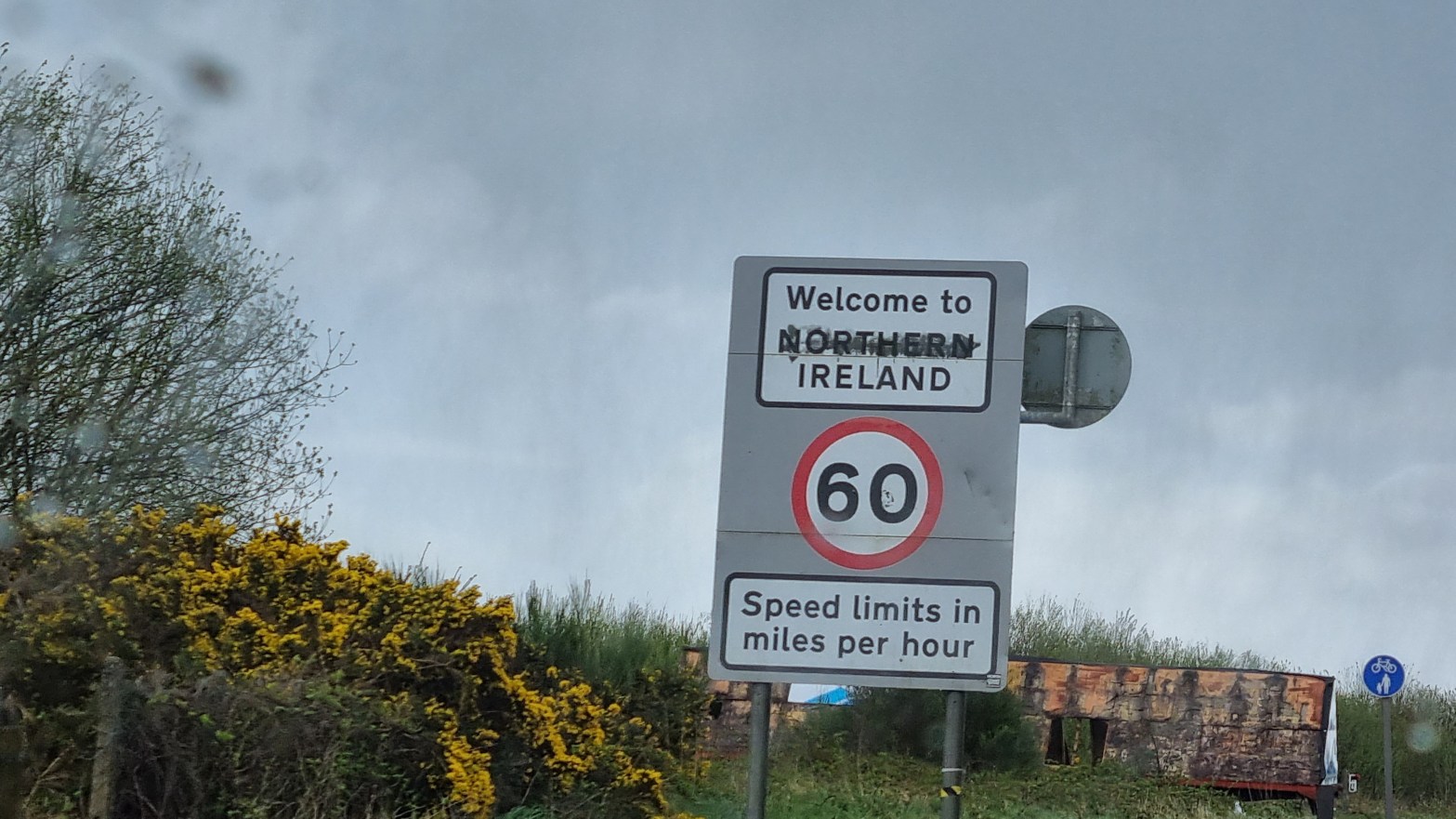
For those who know how to look, Ireland offers to visitors the chance to see overlapping layers of prehistory, history and scenic views. From Dublin, I head for the northern tip of the island, Malin Head, with my eldest daughter, who is a Londoner at heart. The biggest, smallest, most/ less populated, etc…superlatives have always attracted travelers, and I’m no exception.
Friday morning in the waiting room of the Belfast express. It’s full of travelers and … it’s buzzing with chatter, like a Parisian cocktail party! I’m always surprised, but I shouldn’t be, as this little country has managed to win the Nobel Prize for Literature four times… People chat and chat and as we get on the train, an unknown gentleman compliments me on my hat – I look like Countess Markievicz, he says – a huge compliment from an Irishman! There’s always someone to make you feel good about yourself in this country.
I’ve got a big suitcase that I’m having trouble fitting in, because the luggage shelves are full of…shopping carts. The carts and their owners disappear as soon as we get in Newry, the first town in the UK after the railway border. They will return to Dublin that same evening filled with British goods (see forthcoming article, « Ireland and the Brexit »).
I meet my daughter at Belfast city airport, an airport with miniature airplanes in the middle of Belfast, crowned the UK’s most convenient airport. It has only been operating for the public since 1983: an average wait at security of 6 minutes, a total of 10 gates, and flights ending at 9:30 p.m., a joy for people in a hurry. As a bonus, one can try the Bushmills on the way back, a matter of priority.
The airport was named George Best in 2006, not in memory of a British king, but of a native footballer who became famous with Manchester United. In Belfast, nothing is simple: this naming divided the city at the time, a native of Belfast playing for the English, you wouldn’t think of it, and if we add the fact that this notorious and unrepentant alcoholic had been prioritized for a liver transplant… « Gorge Best Airport » or how to turn sportsmen, Catholics and the NHS against each other… Anyway, the advantage of a small airport is that everything moves fast, and 15 minutes after my daughter’s landing, we’re on our way for a road trip between Northern Ireland and the North of Ireland, with the anglo-irish Ed Sheeran’s music coming out of the loudspeakers.
Notwithstanding the recent history of the Troubles, Derry is very pretty. We pose in front of the Free Derry Wall, walk around the magnificent city walls and admire the sunset reflections in the River Foyle, crossed by the recently built Peace Bridge, which separates Catholic Bogside from the British habitat. To stay in the mood, in a delightfully old-fashioned B&B exactly three meters from the city walls, we begin to watch the Derry Girls series: or how to live a teenage life like any other, between checkpoints, segregated education, first love and overbearing parents. Video culture has become nomadic, thanks to Netflix.
In the car the next day, the Cranberries still in our ears, we set off for Malin Head, the northern tip of the island! Fun fact: the northern tip of Ireland isn’t in Northern Ireland. Malin Head is the prototypical Ireland: little thatched cottages here and there, lots of grass and broom blown back by the wind, and the cliffs that drop sheer into the sea facing Scotland. It’s sublime.
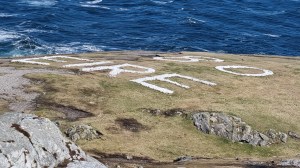
Facing the sea, in huge white letters visible from satellite, the EIRE 80 sign indicated to World War II pilots that they were entering Irish airspace. Ireland was a neutral country, and if a British pilot landed in what was known as the Irish Free State, he risked imprisonment. A 4-mile air corridor had been established during the war between an RAF base in the south of the province and the northern tip to allow planes to come and go, but no more. These markers were numbered from 1 to 82 from south to north and allowed pilots to find their way before the advent of radar and GPS.
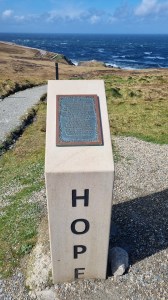
Since 2022, Malin Head has also been home to a « bench of hope », a stone with a moving poem, installed here by the Darkness into Light association whose founders lost a son, and who have since been committed to improve the mental health of young people. This stone and this magnificent poem facing the sea are very moving and call for meditation.
The road at Malin Head is clearly marked by a Start/Finish line for the various charity walks or runs that culminate here, and whose memory is anchored on plaques in the tower that dominates the headland. The charity system here relies exclusively on private funds. For the Irish, it’s a matter of principle to give both money and time to charity.
Altogether, Malin Head is a fantastic sight, to which the Irish have superimposed a double commemorative meaning. Everything can be read on several levels in this country. And we have further proof of this a few kilometers further on, as we seek at the end of a tiny steep road the « wee house of Malin », where a statue of Virgin Mary cohabits next to a small cave that was sacred in antiquity. The Irish definitely rank very highly for the syncretism of Pagan and Christian cultures.
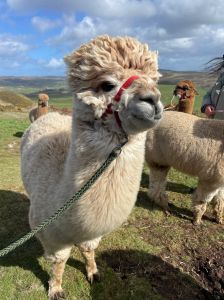
We extend our discovery of Malin Head with a walk in the company of alpacas on the Wild Alpaca Way… the meeting point is high up and so remote that we are forced to drive reverse for 500 meters and two turn in order to pass a car coming down, adrenaline guaranteed. And we silently thank our guardian angels Insomnia and Red Bull.
The walk is an enchantment, each walker with his own alpaca. For these animals accustomed to the climate of the Andes, the cold winds and the Irish cliffs are a piece of cake. The organizers make sure that everyone has several photos with their alpaca, and so we find ourselves immortalized three times with Bruce and Button. These big sheep with their pronounced gregarious instinct, are extremely gentle in both touch and character. An hour on the Wild Alpaca Way is a week’s worth of cuddles!
Hearing that I’m teaching at Trinity College, the tanned boss of the flock tells me that he’s bought 50 acres of cliff in 2019, that he’s very happy with his 50 alpacas, and that his brother is a professor holding a chair at an excellent English university. Far from being a sectarian, he is equally proud of himself and his brother, saying that they have the best of both worlds. This family eclecticism reminds me of pubs, which mix ages and social backgrounds. Food for thoughts.
Sunday morning in Letterkenny: for those in search of their daily dose of caffeine, it’s an arduous task: there are a number of cafés in this small Donegal town, all of which have a Sunday break, except Insomnia. I’m there, in need of caffeine, exactly 5 minutes after opening time… and the café is already full. I’m very kindly being taken care of (with my French accent, it’s hard to pass myself off as a local haha) and as soon as I get out, my beverages in hand, the young baristas come out from the counter to chat with the seated customers…whom they obviously all know.
We arrive at Glenveagh National Park, surrounded by peat on the road, and of course sheep, but above all peat to the left, peat to the right, peat in front and peat behind, it’s almost dizzying. Glenveagh Castle sits on the edge of a lake and is worthy of a TV romance, reminiscent of the Scottish version of Kylemore. It’s surrounded by a magnificent, well-kept walled garden, an art the Anglo-Irish excel in. Someone once told me that French women spend most of their time cooking food and arranging their living rooms, whereas English and Irish women spend most of their time in the garden. And then entertain in the well-maintained part of the house. That’s true somehow.
The next day, we set off for the Giant’s Causeway. On the audio side, we stick to the Anglo-Irish friendship and move on to Niall Horan and Harry Styles. The further we go towards Derry, the greener the meadows become, and the sheep continue to graze as if nothing had happened. A quick, windy stopover at Grianan on Aileach, a prehistoric fort used well into medieval times. The fort is situated at the top of a hill, rather difficult to access, but this guarantees us a breathtaking 360-degree view over the whole valley, with the added bonus of an icy breeze – in fact, there are remnants of snow on the steps. It’s the middle of April!
The breeze chases us to Bushmills, home to the oldest whisky distillery in the world, and the owners proclaim that they’ve been here for over 400 years (1608) and have no intention of leaving. Bushmills is now owned by the American Proximo Spirits, but they maintain the Irish spirit of the house. The charming village and the old distillery amalgate: « Without the village, there’s no whisky, and without the whisky, there’s no village », as they themselves put it. After admiring the traditional houses, we stock up at the gift shop. Sure, you can buy whisky elsewhere, but not with a personalized label, and what’s the point of making a trip if you don’t bring back souvenirs to prolong it?
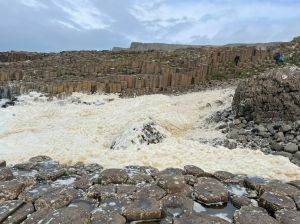
We finally arrive at the Giant’s Causeway, the cold breeze is still there, amplified, creating bubbles of foam between the basalt octagons, which is both magnificent and terrifying. We zigzag between rock and sea as best we can – nature in Ireland must be earned. Tip for future travelers: bring good shoes and a good windproof jacket, no matter the season.
And we finish our tour in the hotel next door by the fire, enjoying an old Bushmills with a Sticky Toffee Pudding… walking with adverse wind burns calories, so we need to refuel. Back to Belfast the next day, Sinead O’Connor’s voice in our eardrums, may she rest in peace.
Having tackled the big trucks and the rain on the highway, the sheep and tractors on the country roads, poor signage and narrow parking lots in town, the reversing speed on a mountain road, my daughter – a truly excellent driver – tells me that now that she’s taken up the Irish challenge, she’s ready for the next one. To be continued.
And so it is that after 4 days, 500 kilometers, 300 pictures and 9 episodes of Derry Girls, we leave Belfast, filled with gratitude for this journey. It was maybe small, but full of breathtaking History, stories and landscapes…
Pauline Chatelain


again a wonderful article on Ireland – one will want to drive over right now to meet the Alpacas and sense the wildness of the North of Ireland … love it
J’aimeJ’aime