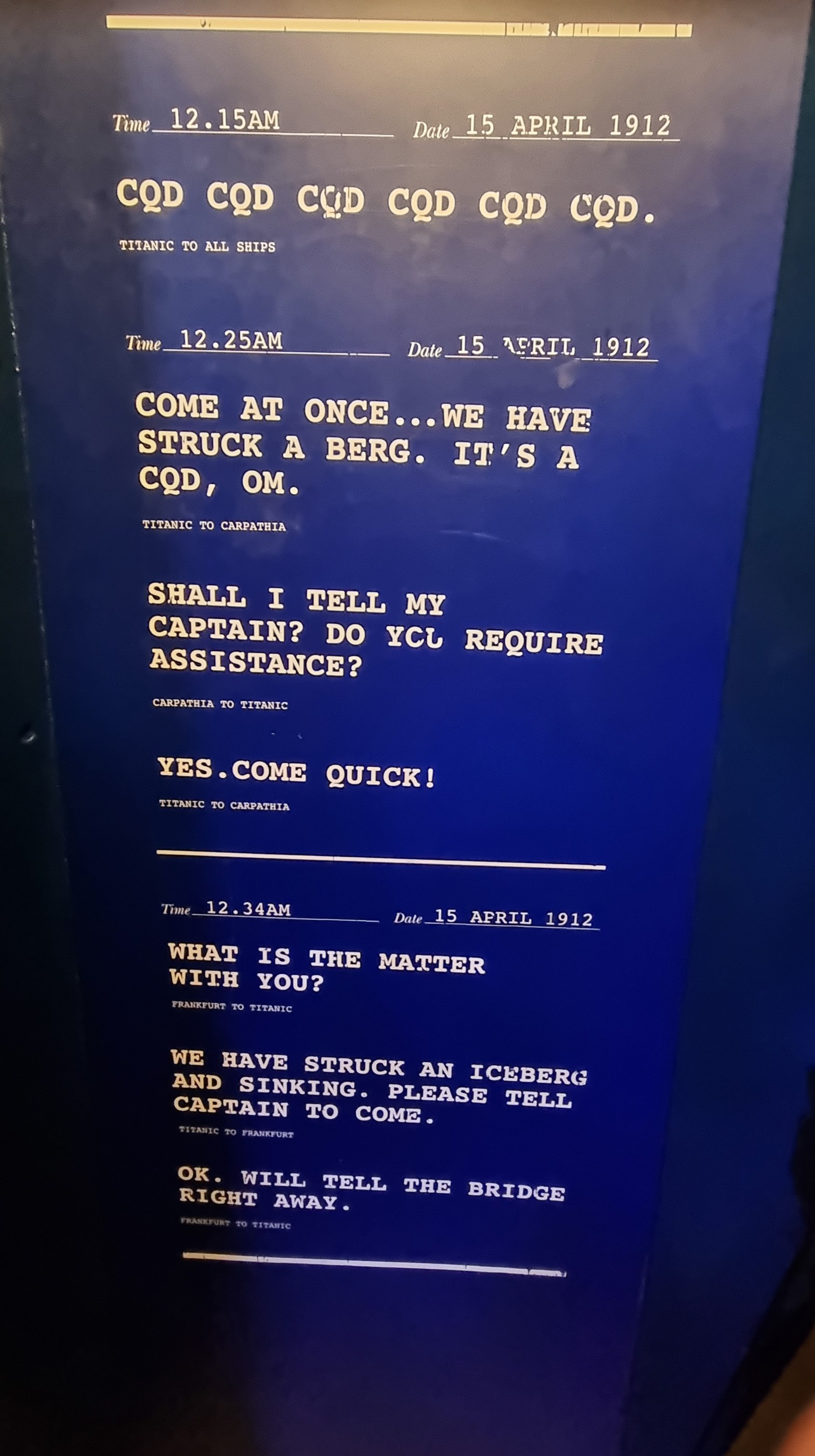
The name we give to things always matters. Naming the vessel TITANIC, (or the TITAN for her infamous observer), was she then doomed to a tragic end? The Titans were the very first gods of the Greek mythology, but defeated in the second generation by the gods of Olympus. Well, Greek tragedies always end badly. It took less than a generation to defeat the Titanic and the Titan.
Far from idealised pictures and romantic Winslet/Caprio-style clichés, the Titanic Museum in Belfast is definitely worth it. If only for all the stories it tells and the moral lessons to be drawn from it.
The Titanic still lives on in the western collective memory, even if she sank in 1912, more than a century ago, a rare thing. The Titanic Museum opened its doors in Belfast 15 years after James Cameron’s blockbuster, in 2012, on the very site of the former shipyards. They are located on Queen Island, a portion reclaimed from the sea in the nineteenth century. What a funny idea to want to gain ground on the sea, History teaches us that the sea always ends up winning.
The Northern Irish museum immerses us in the Belfast of 1900, the construction of the ship, her inauguration, the disaster and its aftermath. The visitor is first immersed in Belfast in the beginning of the XXth century. It was a vibrant metropolis at the forefront of the Industrial Revolution and social progress, also offering more professional opportunities for women than the rest of Ireland. Belfast was renowned for its linen work and shipyards. It was a simple equation of supply and demand that triggered the construction of the Titanic by White Star Line, also in order to face competition from other shipping companies. Indeed, at that time, many people were emigrating to the New World, more than 8 million between 1900 and 1916, which prompted the order of the largest ship ever built. And so begins a huge 3-year construction work in Belfast, in which the visitor is immersed thanks to clever underground wagons. The project was completed in 1912 with the Titanic and its twin sister Olympic, the Titanic being slightly bigger and so the largest moving artefact ever built by humans. The museum then takes us on a re-creation of the boat’s launch, before being equipped and tested. A large proportion of Belfast’s inhabitants had contributed to her construction, either directly or indirectly, which explains the huge crowds when she was launched. It was said to be unsinkable, everyone at all levels believed in it. Finally, the visitor is led to the stages of her journey, both maiden and fateful.
One admires the logistics designed to accommodate, entertain and feed 2,200 people, including about 1,300 passengers, for 8 days. In fact, if it hadn’t ended so quickly and so badly, the Titanic would certainly have been judged by posterity as an impressive blend of mechanical marvel and logistical organization. Judge for yourself: the crew consisted of 61 people on deck, 317 mechanics and sailors, and 507 in passenger service! The boat was full of linen, carpets, textiles and porcelain for the comfort of the passengers. The boat was also full of food: 75,000 pounds of meat, 40,000 eggs, 1,000 loaves of bread… and 8,000 cigars to name just a few examples. The boat had large private cabins in first class. Although there were only two bathrooms for all 3rd class passengers, they had individual sheets and were served at the table by uniformed staff : quite an incredible luxury for the time !
In Southampton, the ship departs under the eyes of a much more moderate public on 10 April 1912 at noon. Four days later, it would take less than three hours to sink after hitting the iceberg, accompanied not by an ancient chorus but by the continuous music of the eight musicians, all of whom heroically perished. Only 32% of the passengers were saved. In the museum, a large wall on which each victim is inscribed by name in large letters inspires recollection, a beautiful tribute.
Another one, absolutely enormous, on which all the transcripts of the investigations, researches, interrogations are taped on makes ones head spin…In fact, the causes of the disaster are multifactorial, and if only one of the following factors had worked correctly, the outcome would have been much less tragic:
1 Winds had pushed the icebergs farther south than usual that year. The telegraph was working well in 1912, information was transmitted almost simultaneously, the crew was aware of it.
2 The Titanic had been designed with retention hatches that were too low, largely insufficient to prevent it from sinking. In addition, the 3 million rivets that held the hull contained a lot of slag which made them more brittle in cold weather. These two factors have accelerated the advance of water. The shipyard, however, had never built such a large ship, it was, let us repeat it, the biggest ship ever built.
3 There were not enough lifeboats for everybody, 20 instead of the 48 planned by the designers, the number had been reduced for aesthetic reasons. Like the following informations, it was legal at the time.
4 The two binoculars were missing. In fact, they were indeed in the trunk of the crow’s nest, but the key had been taken by the mate officer, who was enlisted on another ship at the last minute. As a result, the crew’s eyes were relied upon to see icebergs, and it was a moonless night. The iceberg was only seen at 400 meters, and it took twice as much to stop the boat.
5 Captain Smith had not reduced speed despite the ice warnings he had received and read. Smith was a well-known figure, nicknamed « the Billionaire Pasha », and he was determined to arrive on the scheduled day and time in New York for his very last boat crossing before retiring.
6 The ship’s telegraph was primarily used by 1st class passengers so that they could send messages to their relatives and colleagues ashore. The overwhelmed operator did not pass on the last ice warnings received.
7 In the immediate aftermath of the impact, many of the passengers opened their portholes to see what was happening, which were then left open as they fled, which accelerated the sinking.
8 The crew had not been trained with emergency drills, which resulted in not all lifeboats being used to their maximum capacity. This would have saved more than half of the crew and passengers at least. It was later calculated that the lifeboats could have even carried even more people than the number for which they were certified. 2 hours and 30 minutes would have been more than enough to evacuate everyone.
9 The Titanic’s SOS was not heard by the Californian, which was the geographically closest boat, just 5 miles away and in the Titanic’s field of vision, because the operator was..in bed. The Californian could have been on the scene before the sinking was over.
It is therefore a mixture of weather, poor legislation, client-based approach and ego that has led to the disaster and the human toll that we know.
In the end, it was the Carpathia, 67 miles away, that picked up the survivors. She reached the scene about 1 hour and 40 minutes after the sinking, and took in 711 passengers and 3 dogs (there were 12 in total on the boat).
The wreck was only located in 1985 and attracted many curious people and treasure hunters, unaware of the abysmal depth of its burial, 3,821 meters: it’s the Aiguille du Midi upside down! It recently ended badly for the Titan on June 18, 2023 as everyone knows. There are only 10 submersibles in the world capable of reaching such depths, and the Titan was the only one that had never been approved by an outside agency. A whistleblower about the reliability of the Titan was even fired by Oceangate in 2018. But that didn’t stop many people, including a seasoned diver, from foolishly ending up imploding right next to the coveted wreck.
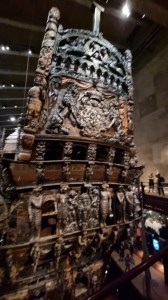
Another famous wreck has been recovered and can be seen in its entirety, another very rare thing. I am referring to VASA in Stockholm. My husband and I had come for an hour to Vasamuseet, we stayed there almost the entire day…
This magnificent ship had also been commissioned and built for three years, in the middle of the 30 Years’ War, in order to establish Gustav Adolf’s military supremacy. The enemy had to be impressed, hence the staggering number of exterior decorations. The Vasa was much larger than the ships usually built at the time, the shipyard contractor had requirement specifications : it was mainly necessary to visually display the Swedish power, by the size of the ship and the multiplicity of its figureheads. By focusing on its appearance, the contractor, who was under pressure from the king, had misconceived the balance of the boat : with a waterline that was too low, she was doomed to sink. It happened, less than a nautical mile away during her maiden voyage on August 16, 1628, with all the ports open so that the many spectators could admire the cannons… ports into which the water quickly rushed. And what had been thought of as a warship inspiring terror as in a Greek tragedy ended up as a tragicomedy, directly in Stockholm’s harbour. When you know that the construction of the ship had cost 25% of the country’s annual harvest…
The shipworm-free waters of the Baltic sea are kind to the wood, and the ship was refloated and reassembled in her entirety exactly 333 years after her sinking. It is a marvel of history and chemistry that can be admired in Stockholm, a magnificent wooden mummy, a unique work of art, both a witness to the past and a warning for the future.
Do you know what a tragic mistake is? This is simply a miscalculation. This was exactly the case all three times. Error in assessing the vessel’s actual needs in the face of the elements, error in assessing the possible dangers once at sea and how to overcome them. TITANIC, TITAN, VASA, the three ships tell the same story: sunk by hubris. In ancient Greece, it referred to human’s oversized vanity, especially when they were tempted to compete with the Gods. If one wants to build a vessel of superlatives, one may forget the essential: it remains a watercraft in front of the natural elements that will be stronger.
Before thinking of impressing minds, it is the nature that we must think about, not in order to impress it, but to which we should adapt.
One ship was supposedly unsinkable but wasn’t, the second supposedly submersible but wasn’t, and the third didn’t even have sea legs!
The biggest, the farthest, the prettiest… before building the next superlative boat, her designers would do well to go and meditate in Stockholm and Belfast.

 Cahiers d'Irlande
interesting comparison between the Vasa and the titanic -love the Greek gods references
J’aimeJ’aime