Ireland is truly not known for being a particularly egalitarian country. Abortion has only been allowed since 2018, homosexuality has been decriminalized since 1993, divorce has been legalized in 1995 (!) . Until 1973, a married woman was not allowed to work for the civil service, she had to resign when she married. It is only since 1998 that a law prohibits any gender discrimination in employment.
There still have been many outstanding Irish women. And this is all the more remarkable in a country where both governance and religion have long worked to keep them in a subordinate role. Here are a few examples.
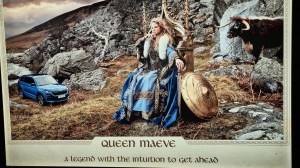
Queen Maeve: legend or reality, we don’t know, but the fact remains that Maeve plays an important role in the Irish public imagination. A symbol of a liberated woman, as talented as she was beautiful, with a strong sexual appetite, she is said to have lived and ruled the province of Connacht (in the west) around 50 BC. She was the daughter of a king, herself an excellent warrior. The best-known legend about her relates to a pillow talk she had with her husband Aillil, each of the two spouses claiming to be more fortunate than the other. After detailed calculations, it turned out that they owned as much property as each other, the only difference being a fabulous bull owned by her husband. So Maeve went in search of a bull at least equal, and having found it in the North, she started a war with the province of Ulster to take the said bull by force! After this bloody victory, the two bulls of the spouses are kept on the same field, and will gore each other until they die,a lot of effort for nothing ..
Even today, the location of Maeve’s presumed tomb near Sligo leads to many speculations, especially as it is believed to have special powers. The queen would be buried upright, facing north, in order to face her enemies in Ulster, a sort of precursor to the Northern Ireland conflict in a way.
A fantasy of an all-powerful woman, an allegory of a certain form of hubris and of the Irish conflict : Maeve means a lot to the Irish. It is no accident, that the name Maeve has recently experienced a strong resurgence, a name that means « intoxicating » or « she who rules ».
Saint Brigid: she is another figure, whose existence seems to be attested, even if some historians disagree. Brigid (451-523) was born to pagan parents, who had given her the name of an ancient Celtic goddess. She decided at a very young age to convert to Christianity and to lead a religious life, which caused her to establish a convent in Kildare. This seems almost trivial in the light of the 21st century, but a woman founding and running an institution in the fifth century was an extraordinary accomplishment, especially since according to the law of the time women were « legally incompetent » : a woman was necessarily defined by her closest male relative, father or husband generally.
The monastic path was one of the few ways of female emancipation at the time, and allowed one to have a social role and a certain authority. An even then, only on the condition that the women had a recognized leadership function, which was the case of St. Brigid.
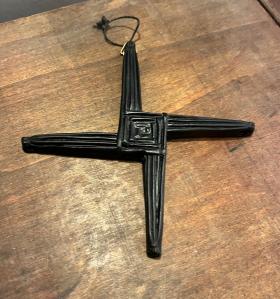
This dual Celtic and Christian affiliation makes St Brigid a fascinating hybrid figure, whose story is bathed in both Celtic legends and Christian tradition. Many myths and anecdotes circulate around St Brigid, for example the goddess is said to have had control of fire and the power to heal animals in particular. As for the abbess, she is particularly known for her cross: in order to convert the population who was mainly rural, she is said to have taken wisps of straw to make a cross (see picture). This cross is then being hung in homes, in order to protect them from fire, hunger, and evil.
St. Brigid died on February 1st, and when she died, the sisters are said to have lit and kept a fire burning in her memory for centuries. This idea of darkness towards light can still be found today since February 1st is a day that for the Irish, coincides with the end of winter, which is quite justified given the temperate Irish climate. The first daffodils of the year appear on the Emerald Isle around this date.
St. Brigid quickly became with St. Patrick one of the great Irish founding figures and is seen today as one of the three Irish patron saints along with St. Patrick and St. Colmcill. The cross of St. Brigid is still made by children in primary school around February 1, which has become an official bank holiday in 2023: it is the very first time in the history of the country that a day is declared a bank holiday in honor of a woman. This is an extremely rare fact on the whole planet.
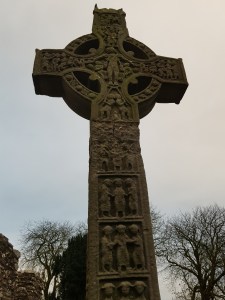
St. Brigid is a perfect syncretism of the Irish religious roots, both Celtic and Christian. By the way, the most beautiful example of this dual roots is the famous Celtic cross which combines worship of the sun god with the Catholic cross (see photo).
This double origin – the fusion of the historical figure and the pagan goddess – makes St. Brigid cumulate : She is the patron saint of poetry, of apprenticeship, of parturients, of children, of healing, of blacksmiths, of cattle… and milk production. When one thinks of the importance of a daily consumption of in Ireland even today, more than bread in France, it emphasizes even more the importance of St. Brigid in the agricultural world and throughout the country!
Let us now move on to Grace O’Malley, a historically attested figure this time, with the Irish name of Grainne Ni Mhaille (1530-1603). She was the daughter of pirates who became a pirate herself. The O’Malley clan was well off. Grace worked hard to honor the family’s motto « powerful by land and by sea, » throughout her life.
The notion of « piracy » was different at the time and the line between pirates and privateers was sometimes blurred. Legal or not, when you consider the fact that the seafaring community is particularly misogynistic, and that Grace activity aimed at resisting the British crown, it highlights Grace’s incredible achievement. She is said to have shaved off her long red hair so that she could manage a boat and its crew without a hitch, hence the nickname « Grace the Bald »… This did not prevent her from marrying twice and having 4 children.
The most famous episode of her life, and abundantly attested, was her meeting with Queen Elizabeth I in 1593 at Greenwich Castle. Grace didn’t speak English, the queen didn’t speak Gaelic, so the two women conversed in Latin. This is also a proof of Grace’s high level of education. It was Grace who had taken the initiative to meet the queen despite the risk (they were ennemies, even if equal queens in Grace’s mind), to set her favorite son free. In fact, she obtained his release at the end of the interview !
Grace O’Malley is the symbol of rebellion against patriarchy and English domination at the same time, and paradoxically the guarantor of traditions (Gaelic lifestyle), but she is also the symbol of an absolute mother, ready to risk anything to save her son.
Finally, let us mention Constance Markievicz (1868-1927). She was born Constance Gore-Booth and came from an aristocratic family in Sligo. She met a Polish count during a trip to Paris and thus took the name Markievicz. The couple’s only daughter was named Maeve, quite a symbol !, and the couple moved to Dublin, where the Countess gradually became interested in the nationalist cause.
Countess Markievicz was arrested for the first time, but not the last, in 1911 during a demonstration against King George V’s visit to Ireland. She was arrested again in 1916 following her activism during the 1916 uprising, she was the only woman to be court-martialed for it and was sentenced to death, but her sentence was commuted to life imprisonment because of her gender. She was released a year later, following a general amnesty. Again in prison in 1918, she was elected to the British Parliament, but like many Irish people did not take her seat because she refused allegiance to the crown.
In 1919, the future Republic of Ireland formed its first government, following the unilateral declaration of independence on 21 January, and Constance became Minister of Labour. She is the first woman in the world to hold a ministerial position!
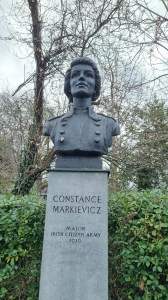
Constance died in 1927 following an operation for appendicitis. She had devoted all her money to her cause and died in the public section of the hospital, surrounded by her husband and Eamon de Valera, the first president of the young republic. A symbol of feminist, trade unionist and independantist, Constance Markievicz is remembered by all, one can see her bust in St Stephens Green.
What all these women have in common is a struggle against the established order and patriarchy. They each broke the glass ceiling by going beyond what was thought possible in their time, and gained the recognition of their contemporaries.
In doing so, they paved the way for what is possible and are role models for future generations. That is also what legends are for..

 Cahiers d'Irlande
see comments in the French version
J’aimeJ’aime