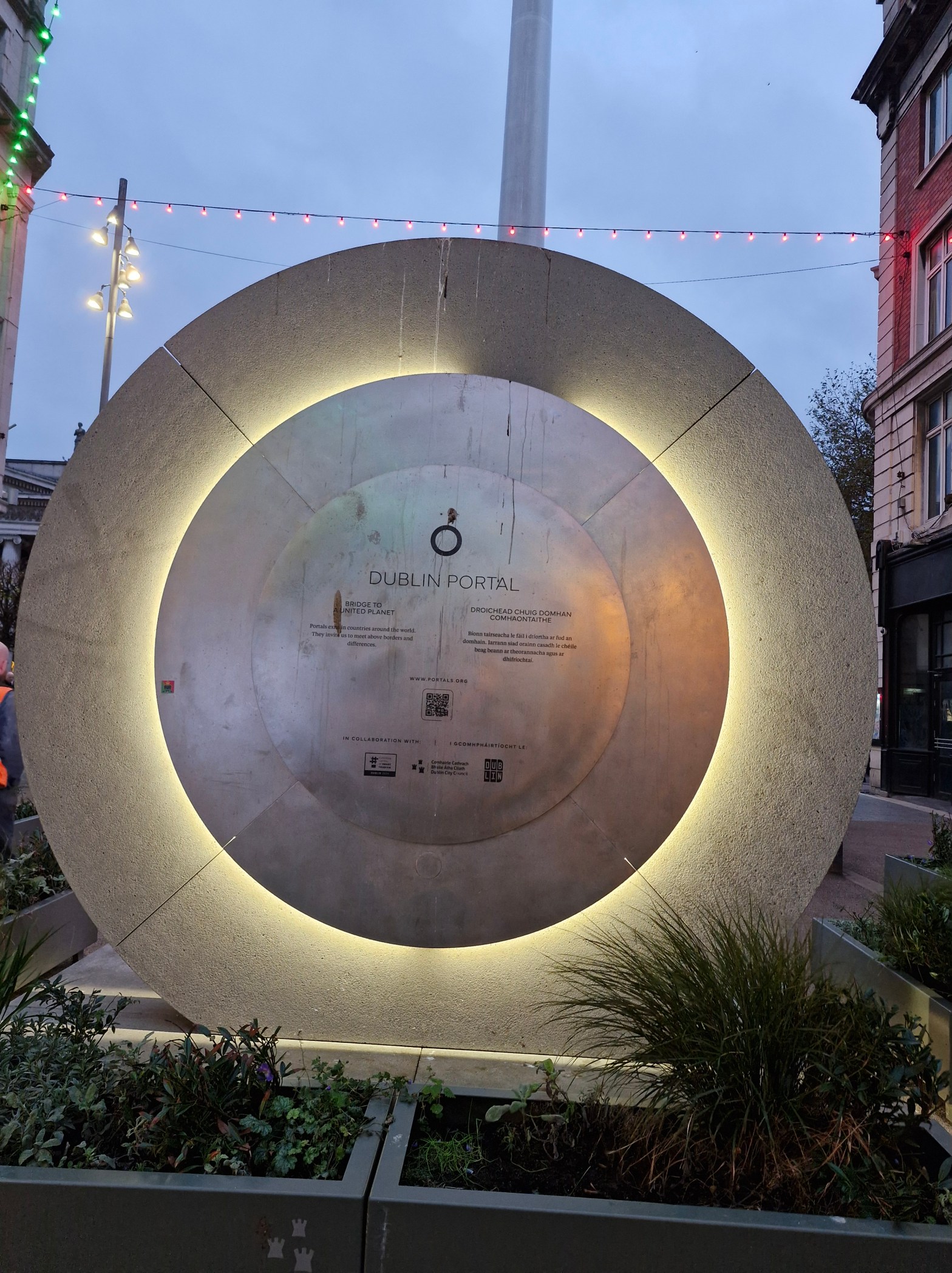
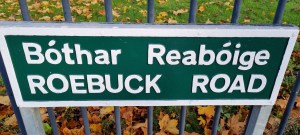
When you come to Ireland, you think you’ll find an English copycat. But the visitor is faced with a kind of permanent cognitive dissonance that can’t be found anywhere else in Europe. Indeed, the country is both very accessible: small towns, small houses, full streets with pubs and shops open 7 days a week, all in English; but it is also extremely unfamiliar, since everything is also in Gaelic, all signs are bilingual (see pic.). And Gaelic is not an Indo-European language, so it’s impossible to recognise the slightest etymology nor to guess the meaning of words, as this would be the case in Spain, Italy or even the Nordic countries. You have the impression that you understand everything and nothing at the same time. It’s as if you’re on familiar ground while constantly looking through the looking glass.
What’s more, the surreal folklore surrounding the omnipresent little green creatures in the shop windows, alongside the equally omnipresent Celtic crosses and symbols, reinforces this impression of strangeness. Both religion and fairies – that’s the generic term – whether in the form of leprechauns, elves, ghosts or banshees – are everywhere as soon as you visit a tourist attraction, shop or historic site.
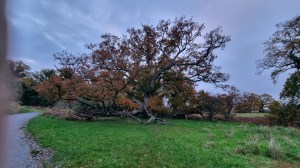
In Ireland, as in Scotland, every self-respecting castle is haunted. The two most haunted castles in Ireland, Leap Castle and Charleville Castle, are in County Offaly, 1,5 hour drive from Dublin. I saw the outside of Charleville after a visit to the very cozy Tullamore distillery, and I should specify a single (delicious) Irish coffee. You have to walk about 1 kilometre through a strange park dotted with old trees and their bent roots. It was November, and there were untrimmed plants here and there, as if they had been forgotten. Even my deeply Cartesian husband asked me to turn back when we got to the gate (see pic.)…
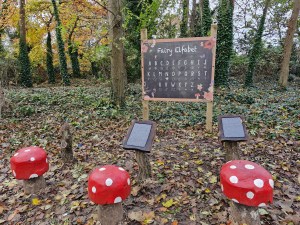
How to find some magic without having to go deep into the Irish countryside? you don’t have to go far… head for Malahide, third on the podium! The castle is a 10-minute walk from the terminus of the DART, a suburban railway that runs along Dublin Bay – it may be an ecological aberration, but it’s a sublime journey along the Irish Sea. The village of Malahide is home to an ancient 12th-century castle, haunted many times over, and to a large fairy garden. Covering several hectares, a host of miniature buildings recreates a world for tiny creatures. The Irish aren’t the only ones to carve out these special spaces, a place that offers a total escape and a connection with nature at the same time. Other examples include Japanese bonsais and the traditions of Scandinavian elves and gnomes. Far from being mere playgrounds for children, these gardens are designed as portals between the visible and an invisible realm. The Malahide garden covers several hectares, and from miniature houses to spell books, road signs, schools and even airports, you can discover a whole miniature world (see pic.).
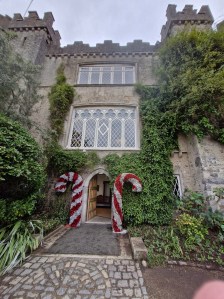
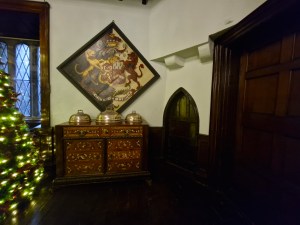
The tour continues at the castle, where the guide explains that a French family, the Talbots, lived there for 30 generations. It is now owned by the state and inhabited by various ghosts only, the most famous being Puck. Puck was a small jester who fell madly in love with one of the Talbot girls. When she didn’t reciprocate, he killed himself in despair, but regularly comes to watch visitors through a small door in the dining room (see pic.).
The Irish are chatty. I’ve mentioned this before while on various buses and trains around the country. They talk, they gossip, they listen. It’s important to realise that this is an old tradition – storytelling. In the rural cottages where large families shared a small space, life was not always easy. In the rare moments of leisure, it was common for storytellers to come and tell stories. The modern Leprechaun Museum in the heart of Dublin is not a collection of kitsch objects, far from it, it’s an hour-long oral immersion in Irish legends, in the warmth of a parallel world. (Tourists with broken english should refrain though).
Among other things, we learn that the leprechauns were traditionally brown so that they could hide in nature, but it was Walt Disney who turned them green, so to speak, because he thought it looked better on a big screen! We also learn that the original meaning of the horseshoe is that the fairies can’t stand iron, which is why a horseshoe protected the houses (and that is why the fairies’ blood isn’t red, because it doesn’t contain iron). We also learn about the origin of the pumpkins carved on Halloween, the ancient Gaelic celebration of Samhain: they are said to have been carved by a certain Jack, who managed to thwart the pact made with the devil and not give him his soul. As a result, he found himself at the gates of both hell and heaven when he died, denied access to both and condemned to wander in limbo. So he carved a pumpkin to put a candle in order to see something in this no-man’s-land. Where does religion end and superstition begin?
At the end of the day, are these frequent references to the supernatural just mere tourist traps? And that’s where it’s interesting to link the stories to history. Between the 14th and 18th centuries, a witch-hunt swept through Europe, claiming between 40,000 and 80,000 victims, most of them women who were burnt at the stake. The only exception? Ireland! Ireland, a very Christian country, with an overwhelming majority of oppressed Catholics and a minority of oppressive Protestants. Yet on the green Erin, only a handful of people were convicted and four executed for witchcraft during this period. This figure is intriguing, and Ireland’s insularity does not explain it, since neighbouring England was heavily involved in witch-hunting. Apart from a few rare trials (Alice Kyteler in Kilkenny and Islandmagee in particular), ‘witches’ were left in peace on the emerald isle. In fact, you have to go back a long way to understand this state of mind.
The fairies are said to be the original inhabitants of the island, driven underground by the arrival of the Celts. Traditional belief thus anchored a cohabitation between humans on land and fairies underground, sharing the island of Ireland between them. Christianity was just added to this this ancient mythology. This deep-rooted belief is probably the reason why the witch-hunt claimed so few victims in a deeply Christian country. Because the idea is always ‘don’t bother the fairies’, the creatures could otherwise take revenge. So, for the peace of all inhabitants, they had to be allowed to live their lives. Religion and superstition have always gone hand in hand in Ireland.
Superstitions from another era, you may say? Not at all! Even today, many families have their own supernatural stories, peppered with fairies, banshees (women who weep to announce the death of a loved one) and leprechauns (clever little goblins never short of a joke). And go to mass on Sundays. Supposed points of entry to this parallel underground world can be found all over modern Ireland. In 1999, the construction of a major motorway between Limerick and Galway, the M18, was delayed for 10 years because the route was to destroy an aupebine bush, considered by the locals to be a fairy bush, the scene of numerous battles between the fairies of Kerry and Connaught, with some people even claiming to have seen strange lights and even fairies’ blood.
A foklorist publicised the affair, predicting misfortune for the construction team and a highly accident-prone road due to the probable revenge of the fairies… and the Irish state, yielding to public opinion and practising the ‘when in doubt, leave it out’ policy, ended up financing a pricey slight modification of the route in order to spare the fairy bush, which is still clearly visible from the motorway today.
Residents and tourists alike, it’s up to you to decide what you want to believe or not, but when in doubt, don’t bother the fairies!
Pauline Chatelain

 Cahiers d'Irlande