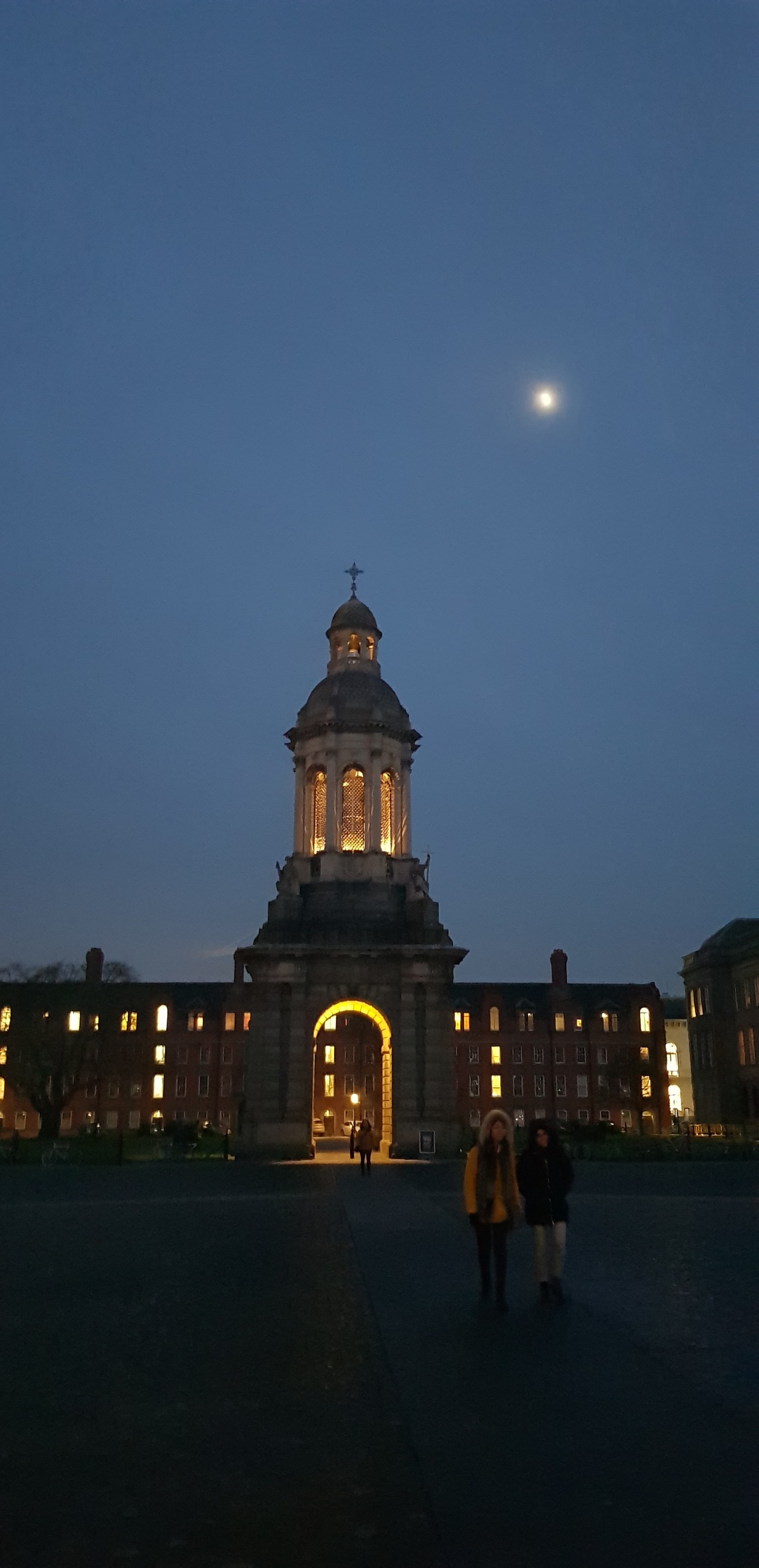
Trinity College is a unique place in the world, both an excellent university and a major tourist attraction, probably the most visited place in Ireland. People will tell you it’s the Guinness storehouse, but in fact absolutely all the tourists come to see the magnificent campus, which is free to enter, and take photos in front of the bell tower, the campanile (see picture), before deciding whether they want to pay to see the Book of Kells and the old library. And that’s not something you can quantify.
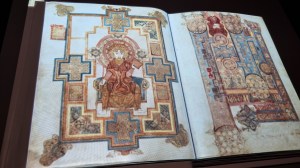
A bit of history: unlike common belief, Trinity College is not a Catholic university, but was founded in 1592 by Queen Elizabeth I. on the site of a former Catholic monastery. 200 years long, it was accessible to Protestants only. Religion is never far away in Ireland. And indeed Trinity is home to a unique artefact: the Book of Kells. The Book of Kells, which depicts the 4 Gospels in Latin with sumptuous decorations, was written and drawn around the year 800 on a Scottish island, and was brought to Trinity by a bishop in the 17th century for safekeeping, where it has remained ever since.
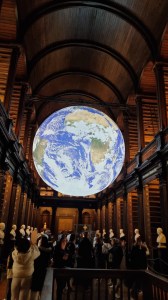
Large colour reproductions in the lobby and a digital display at the end of the visit help to mitigate what I call the « Mona Lisa effect »: tourists crammed in front of a tiny object, and you think all this for that ? Nonetheless, the Book of Kells, because of its age and state of preservation, is an absolutely unique artefact in the whole world. The book of Kells alone is worth a visit to Dublin. It can be visited along with the old library, which is simply outstanding (see picture). This makes the university unique but also vulnerable to blackmail. A group of student activists in favour of Palestine recently blocked access to the Book of Kells and therefore to precious financial resources that the university needs, to fund scholarships among other things.
Current events notwithstanding, in normal times Trinity College is a must-visit for anyone who enjoys unique things and/or reading. Even in the age of smartphones, there are still plenty of them!
Academic on the inside, touristic on the outside, you live with this dual life of the place all the time when you work or study at Trinity, it’s both strange and invigorating. Trinity College is the best university in the country. With its architecture, central location and history, Trinity College is a very special place, and you think of it every time you step through archway. There’s an underlying sense of pride among all the students that they’ve been accepted there. The classes inside, the tourists outside, the great pride inside, the shyness outside, the Gaelic inside, the English outside, many things are double at Trinity as they are in the rest of the country. This creates for the non-Irish visitor or resident a dual sense of familiarity and strangeness that never quite leaves you in Ireland.
The familiarity comes from the English speaking environment, with its terminology, the organisation of the academic year and the exams, many of which are based on the ‘essays’ principle. The strangeness starts with the first names: while their parents’ generation were called John or Mary, the students of 2024 are called Aoife, Oisin, Eoin, Sadhbh… You certainly don’t have to learn Irish, but learning to pronounce Gaelic first names requires a minimum of training, given that there’s a gap between the way Gaeilge is written and the way it’s pronounced.
Teaching at Trinity, that means dealing with very well-behaved students. For the most part, they were in a uniformed and often single-sex school, subject to rigorous discipline. In their first year of college, they discover the freedom to dress freely (and the crucial choices they have to make every morning!) and they retain that typical Irish politeness. As soon as the teacher starts to speak, there’s silence – you listen (or you don’t), but you don’t disrupt the lesson with chatter. It’s extremely pleasant. On the downside, there is is a certain passivity. The students are used to being very guided and won’t take much initiative, including speaking. When you’re teaching a foreign language, which is my case, you need to be creative then to make them talk.
Irish students will generally tell you the truth about themselves. This honesty is sometimes almost disconcerting, when you know that to be excused, all you have to do is send an e-mail with a valid reason before the class begins. Where a Frenchman would have claimed to lie sick with the flu, the Irish student almost naively tells you that they’ve been in Spain with their parents.
Speaking of excuses, this can lead to some hilarious situations when you have to excuse a student who has to travel to the other side of the country to celebrate his great-grandmother’s 100th birthday on the same day as an exam, and yes that is indeed a valid reason to miss class in Ireland.
Family is important, but so is sport. In this area, Irish culture is very present. Ireland excels in rugby and Gaelic sports: hurling, camogie and Gaelic football. Have you ever been to a hurling game ? It looks like Quidditch to us, non Gealic people, minus the broom. Strangeness I’m telling you..As a result, many students are involved in a sports team, whether at Trinity or in their home village. And training is part of their daily and weekly routine, which sometimes involves returning to their parents’ house every weekend to take part in training and games. They are regularly excused from classes for competitions.
Unlike in France, religion is not taboo. There are priests and pastors attached to the university. Completely optional ecumenical services are held regularly and the chaplains announce on the notice board that they are praying for the success of the students during the exam period. Nevertheless, religion is a personal matter, and whether you practise one or not will not cause you any concern.
The Irish students are reflective of the country, at once very proud of themselves, their family and their country, and at the same time looking ecstatic at other countries, especially the big ones. But you can feel their visceral attachment to Ireland. In German for example, they have to give presentations on the Erasmus partner universities and the host city. By doing so, there is always a PowerPoint page presenting the Irish pub or pubs in the town in question.
If you ask them what they plan to do when they graduate, the vast majority will tell you that they will first live and work abroad for a few years, then come back to Ireland. This dual attitude – a desire to go elsewhere and a deep attachment to their homeland – is fairly typical of today’s Irish youth. Long a land of emigration, the country has kept this in its DNA, even though the Republic has statistically become a land of immigration.
For the Irish, Ireland and Family are past, present and future. You can feel it in their speech and see it in their writing. The past is both their history, of which they are generally proud, and the deaths that systematically mean an absence from school, regardless of the degree of kinship. Death is part of life in Ireland : between the wake and the pub meeting after the cemetery, the funeral is an eminently social act. The present is their family, with whom they still live for lack of distance or means, or whom they say they never see enough of if Dublin is too far away. The future is both the return to the promised land of Ireland after years abroad as well as the own family they generally want to start at some point.
The terms are short at Trinity, two times 11 weeks, which creates a mini marathon of exams and essays each term, with a week of simili-break, reading week, in the middle. As a result, the ground floor of the Arts Buildings where I work (it’s the building overlooking Nassau Street) is constantly buzzing from mid-September to the end of November and again from the end of January to mid-April. The rest of the time it’s semi-sleepy. Many of the associations and societies present themselves at the beginning of the year. It’s a good idea to join a few of them. In April, at the end of the school year, the Trinity Ball takes place, a major celebration known throughout Ireland.
During term time, the corridors on the upper floors are full of noise, but not as loud as on the ground floor. They are dotted with seats, tables and sofas (yes, sofas), so it’s not unusual to see a student taking a nap. The Irish are no early birds, and the 9am class is hated by everyone. Add to that the fact that many of them stay with their parents in neighbouring counties, sometimes 50 kilometres away, because families can’t afford and/or find accommodation in Dublin, the inadequacy and unreliability of public transport (no underground, busses that are often late, a tram system that only covers 2 lines) and you get a public with sleepy eyes and a red bull in hand, late for the first hour. Well, it’s also due to the fact that the Irish are party people and for some it was a short night, wasn’t it?
As soon as you step outside, you’re drawn in by both the tourists and the noise of the city. A large university right in the centre of town is very rare, and this is how you move seamlessly from the academic to the urban atmosphere. It’s really nice to have everything you need within easy reach. Add the the tourists to this, hard to miss as they stick together in bunches usually.. who never cease to remind you by their presence that you have the privilege of working in a mythical place that people from all over the world come to visit.
Pauline Chatelain
 Cahiers d'Irlande
Again another wonderful article – nb: If ever I restart my studies at Uni – it will definitively be at Trinity College … thank you, Pauline, for this.
J’aimeJ’aime