NI = Northern Ireland
Mid-October 2023, it’s 25 years after the Good Friday Agreement. How does it stand ?
In order to see the situation more clearly, I go to Belfast and book the group « political walking tour » in West Belfast: I am told that it will be a 3-hour walking tour, 4 kilometers in total with two different guides from both sides of History. I came out of the tour after 3 hours and a half, my body shaking uncontrollably and my fingers numb on the verge of hypothermia but oh, so impressed !
I’m going from Dublin to Belfast by train. The Belfast Express is always full, you have to book in advance, there’s even a dedicated waiting room in Connolly station. The journey lasts a good 2 hours in a very comfortable train; meanwhile the carriage buzzes with chatter. People obviously travel in small groups and they yarn and yarn.. it’s no wonder that small Ireland has won four Nobel Prizes for Literature!
You don’t notice the border, the train runs without stops or controlls. Only the sporadic presence of Union Jacks flags in the surrounding countryside indicates that we have entered the United Kingdom.
The heart of the Troubles, that was West Belfast, with a population of almost 100,000 and a clearly separated settlement between the two factions.
The tour starts at Falls Road, a nationalist stronghold, at the foot of the infamous DIVIS tower (see article « The Troubles »). That’s the only tower of the complex still standing and inhabited today. It marks the beginning of West Belfast behind the A12 westlink.
The first guide speaks fast and passionately, with a strong Northern Irish accent (advantage to anyone who has watched the series « Derry Girls » in the original version on Netflix). He is a former IRA agent, enlisted at a very young age, arrested at 18 (we won’t know why) spent 6 years in prison, lost his brother and best friend in the conflict. He was lucky, he says, as he is alive and can watch his grandchildren grow, but he says it himself, it was a close call for that not to be the case. He admits from the beginning that yes he wanted to kill people, but no, it’s not the solution. « There is no justification for the abuses committed by the IRA, there is absolutely no justification for killing civilians », he said loud and clear. And he repeats like a mantra how happy he is that NI has solved its conflict.
West Belfast is not a wealthy area, the inhabitants do not own their homes, these are council housing. That said, at first glance, the neighborhood is rather nice: apart from the DIVIS tower, there are no tall towers of housing units like in the French suburbs, but one sees family houses. West Belfast is actually made of rows and rows of neat little pavilions, often with gardens. The garden plots are well-maintained, the streets too, the traffic is limited.
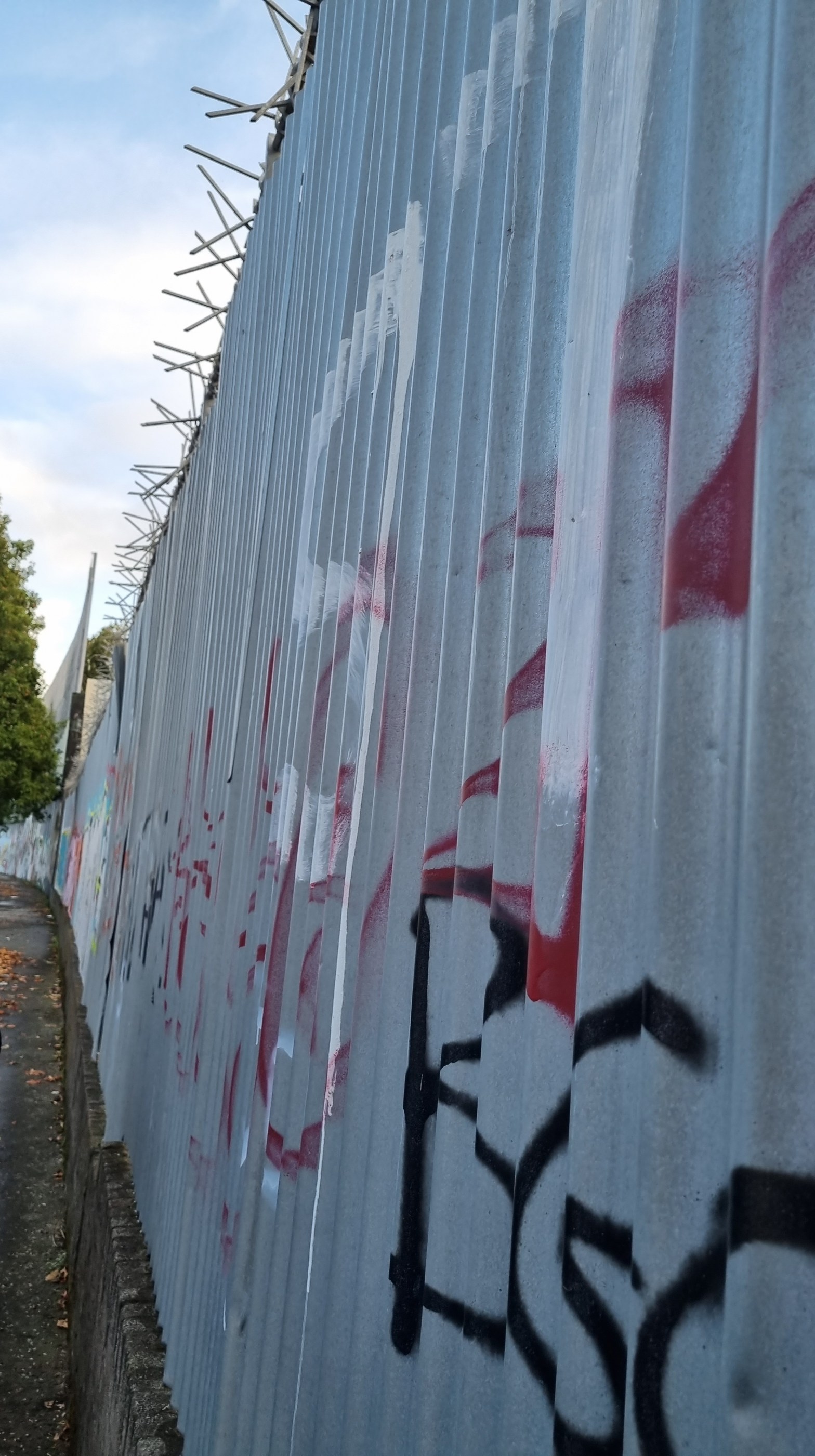
Then, as you walk, the eye is quickly drawn to the barriers and walls. 7,3 km of walls. These side walls separate streets in order to avoid potential incivility and to secure both sides. Not only do the walls still exist 25 years after the signing of the Good Friday Agreement- there are about 60 of them – but their doors also close every evening at 7 PM, to reopen every morning at 6 AM. Some of them were even built after 1998, in order to avoid daily clashes. Is there a way to still get through in the evening, we ask the guide? The answer is no. As a result of skirmishes, even the service doors close at 7 PM now. If the doors are closed, you have to go around the walls.
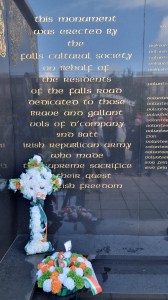
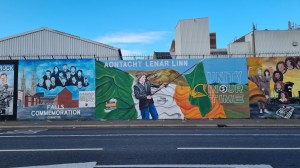
And the guide goes on telling us who was killed, murdered, « slaughtered » by the British Army, the UVF and affiliated at this or that place. The murals – which are numerous, partisan and talkative – are here to support his telling.
We are being transferred from one guide to the other, exactly at the scheduled time, on a street without paintings and by a simple nod from the two guides, without a handshake.
The second guide has a very British accent, speaks more calmly and emphasizes articulation. He begins by giving us figures, which he knows by heart: the number of inhabitants on each side, the number of deaths, the number of killings, he knows everything down to the last unit. You can feel him grieving too, he has tears in his eyes when he talks about the deaths of children.
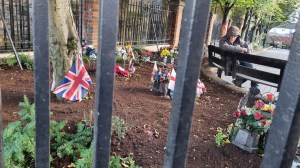
It then becomes clear to the visitor, that West Belfast has absolutely everything in duplicate: homes, schools, shops, libraries, pubs, hospitals, and of course, churches. On a day-to-day basis, the two communities do not mix at all. And all of a sudden, the little family houses take on a disturbing connotation, somewhere between a fantasy movie and a dark novel. And this is also the moment when the visitor realises that in West Belfast, the tour is actually about following two guides from gardens of remembrance to murals, from crosses to wreaths of flowers. You have to understand that even in the middle of the afternoon you hardly meet anyone for 3,5 hours, apart from the other groups of tourists who are easily spotted, and the children and teenagers coming out of their respective schools. They walk in small groups and all wear a uniform.
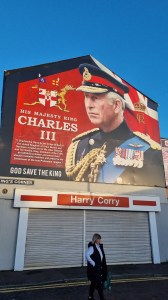
And the loyalist guide takes us from bomb to mural, telling us who was killed, murdered, « slaughtered » by the IRA. No mention of British rule over the Irish. On the contrary, he gives the impression that the loyalists, in turn, feel kind of surrounded. And repeats like a mantra how sad he is about all this past and worried about the future. He feels almost under siege: what if Sinn Fein wanted the whole island of Ireland to the Irish? The tour culminates on Shankill Road, a loyalist stronghold. Nearby a recent giant portrait of King Charles, a memorial lists and displays here pictures of all the British victims.
Even on Shankill Road, which is a shopping street, you don’t see many people, and by 5:30 PM, the shops start closing one after the other, not by just closing their doors but by lowering their heavy iron curtains.
Our guide is not stingy with his time: after over 2 hours instead of the planned 1h30, I thank him and leave Shankill Road, between the walls and the small red brick houses at sunset. It’s well after 6 PM, the curtains are down, the streets are empty. Only a few children play outside near the many skeletons, ghosts and other Halloween artifacts, giving the neighborhood an almost gloomy atmosphere of Gotham City. Because of my notes and many pictures, my battery is dead. I don’t have anything to guide me, my sense of direction being bad, I orient myself with the DIVIS tower protruding in sight, and I pray that I can get out of West Belfast by 7pm, otherwise it would take me hours to get around the miles of these cursed walls.
I finally manage to cross the A12 bridge and leave West Belfast. I find myself almost without transition in the center, in a « normal » city, and it’s a vibrant one on this Friday evening: some shops are still open, the pubs are full of customers having a drink, there are lots of people in the streets, a happy urban mix of locals and tourists. You can see old buildings next to new constructions, and a whole lively crowd ready to enjoy the weekend at the restaurant, theatre or opera.
I warm up my incipient hypothermia in a pub with a nice dish of Irish salmon and potatoes washed down with a glass of Commonwealth wine, before heading back to the hotel. My hotel is invaded by a group of Italian pensioners, soo loud but also soo friendly. They are obviously delighted to be on a group trip in NI ! I feel like I’m stepping out of a parallel reality…
The contrast between the two Belfasts is also striking the next morning: St George’s Market is crowded, it welcomes a lot of tourists and there is no sectarianism, they even accept Euros, which is very rare in NI. There are many lively cafés where you can take a hot break near the busy malls. You can also see a lot of walkers along the elegant sunny quays bearing royal names next to the old shipyards, lined with pretty sculptures. Belfast centre on Saturday mornings, is actually a very nice city to be in.
While waiting for my train back, I replay the film. Between « sectarian permafrost » and vibrant modernity, Belfast astonishes and interrogates the visitor.
The two guides agreed on two things:
• In NI, it is not a religious conflict, the Catholic or Protestant religion is just concomitant, so their saying.
• The situation in NI offers parallels with the Israeli-Palestinian conflict (more to this topic in a forthcoming article, « Ireland facing Brexit »).
Apart from this, the general tone of the two guides was very different: the Irish guide was appeased, he took responsibility for the past violence and rejected the idea of future violence. The British guide was tense, worried even, he blamed the past violence and wondered about the future.
On the Irish side, people considere more and more a future reunification of the island. The possibility of a referendum on self-determination is enshrined in the NI constitution and would not pose a legal difficulty. However, the British guide affirmed that a referendum would not pass and at the same time that his people were ready for any eventuality, literally telling us « we prepare for peace, we prepare for war »: will it be necessary to defend their territory?
I wonder: what is West Belfast then? A ghost town? A museum city? No, because almost 100,000 flesh-and-blood people live there, or rather cohabit with a number of ghosts that they bring back to life permanently. It is a statue of salt like Lot’s daughters in the Bible. For three generations, children have been born and raised in this frozen environment, surrounded by memorials.
The two guides were in their sixties, there is a lot to forgive on both sides, that much is clear. But there is also the whole generation of Peace Babies, those children born after 1998, who did not grow up with checkpoints and barricades, and who, despite the countless commemorative plaques and mural paintings, refuse to take up the fight of their parents and ancestors. Will they be able to tip the scale?
The Belfast Express to Dublin is just as full as the outward journey. People chat less, because it’s game night and most passengers watch the Rugby World Cup live from the Stade de France on their cell phones; even my neighbor, a lady well in her forties with a very classic look, that’s to say!
Bobby Sands’ granddaughter, who bears the pretty Celtic name of Erin, won the « all-Ireland » Gaelic junior football cup with her team this summer at Croke Park, that is Dublin’s legendary stadium. Men and women, young and old, Catholic and Protestant, well off and working-class, loyalist and republican… Gaelic or rugby, the sport is « All-Ireland » and unifies them all, even if only for a short time.
Pauline Chatelain

 Cahiers d'Irlande