Once upon a time, two cats fought to mark their territory. The battle was so fierce that in the end only their tails were left. And that was the beginning of Kilkenny. The expression ‘fight like kilkenny cats’ has even become a set expression. As a cat lady, I was fascinated by this legend and its lexical ramifications, so I’ve decided to go spend two days in Kilkenny with an Irish friend, an open minded dog lady.
At first glance, Kilkenny is just another small Irish town, with narrow streets, a mix of pretty old houses and more modern ones, no high-rise buildings in the town centre. But as you look around, you realise that Kilkenny is a town full of history, making the most of its threefold origins: religious, merchant and mythic.
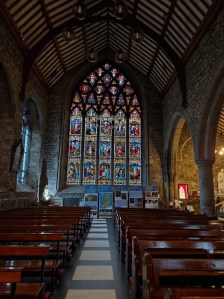
‘Canice’, or ‘Cainnech’ in Gaelic, ‘Kenneth’ in Scotland and ‘Kenny’ in England, from whom the town of Kilkenny takes its name, is an attested historical figure, a monk of the 6th century. He helped to evangelise Ireland and Scotland. It is from him that Kilkenny takes its name, literally ‘Kenny’s church’ (a ‘cill’ lis a church in Gaelic). It was a time when Druidic traditions were competing with the emergence of Christianity and were gradually losing ground. County Kilkenny was the last area of resistance. After his return from Scotland, Canice’s final mission was to Christianise the county, in particular by founding a monastery. The three nearby churches – St Canice’s, St Mary’s Cathedral and the magnificent Black Abbey – still bear witness to the importance of these religious foundations in a relatively small town.
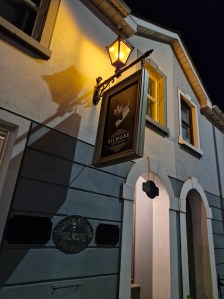
But that doesn’t stop cat emblems proliferating, and here we have our mythical dimension rubbing shoulders with religion. As I’ve written before in this blog, religion and mythology have always gone hand in hand in Ireland. I find my first cat at the entrance to the guesthouse, which you can spot by its sign featuring a cat in a dinner jacket. Very chic. And cats continue to dot the city, whether as pub logos or statues.
The mythical becomes superstitious in the evening at the Kyteler Inn, a must-see pub. Alice Kyteler – also a major social and political figure in the county – founded the pub in the 13th century, which quickly became a renowned entertainment venue. Dame Alice also buried four husbands, which attracted suspicion and earned her the dubious honour of being the victim of one of Ireland’s very few witch trials (see article Magic Ireland 3/3). It is now assumed that, she just had sufficient knowledge of botany… she did, however, become very wealthy thanks to her close widowhoods, didn’t she?
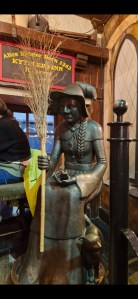
She managed to escape to England thanks to connections, but her maid Petronilla ended up being burnt at the stake in her place, so much for social justice. The pub still exists centuries and centuries later, making it one of the oldest in Ireland, with excellent pub food and a cosy atmosphere with exposed stonework and traditional music. There is no evidence that Dame Alice ever had a cat, but myth and superstition go hand in hand, and the pub’s emblem is a cat. Black, of course. And customers can admire a magnificent statue of Dame Alice on a broom inside the pub. This doesn’t stop the locals going to mass in one of the town’s three churches every Sunday.
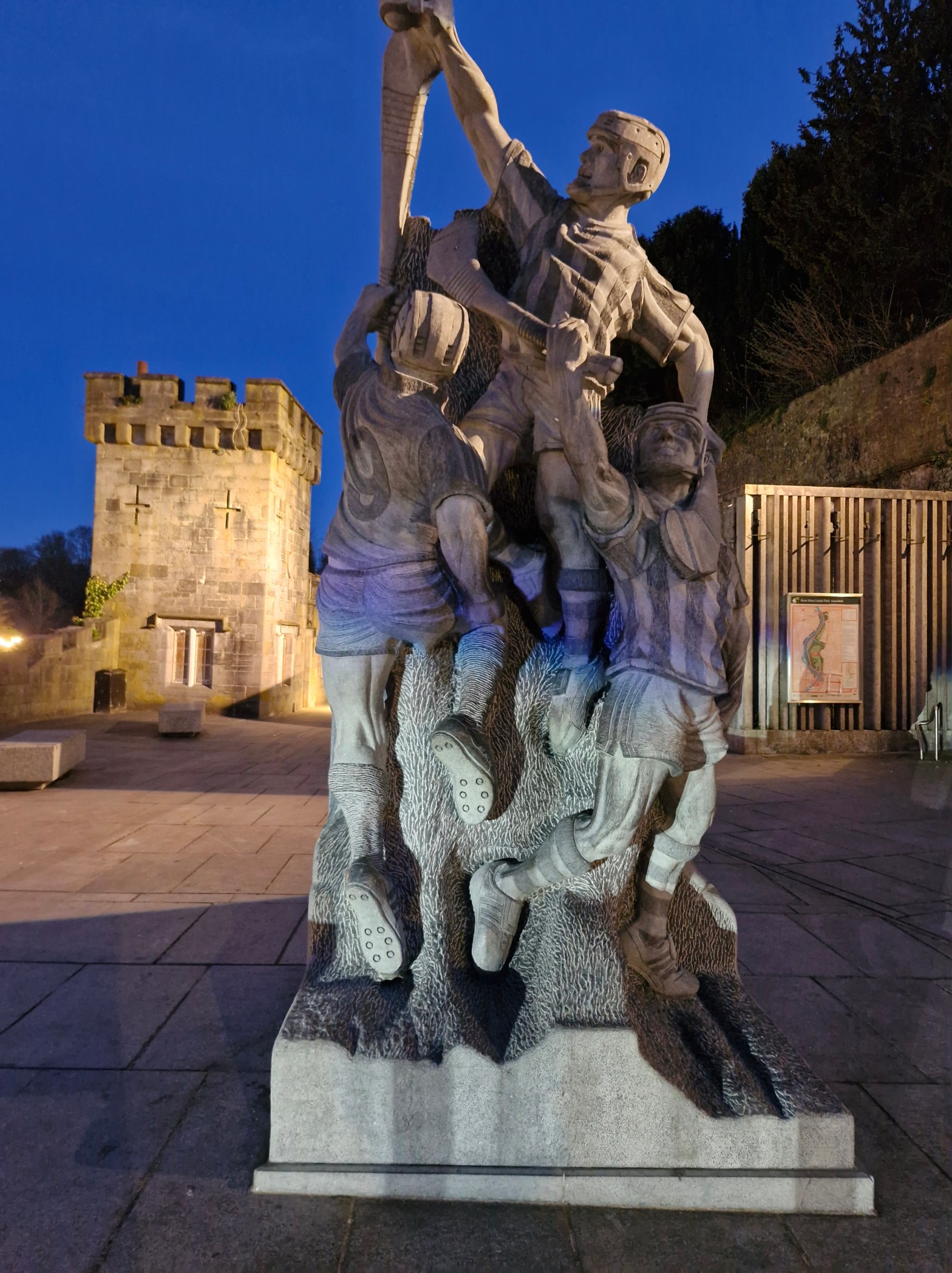
Let’s carry the cat metaphor by telling you that both the locals and the local hurling team are named the “Kilkenny cats” in their honour. Since their first victory in 1904, the kilkenny cats have won the all-Ireland hurling tournament 36 times. In fact, the expression ‘kilkenny cat’, when used to describe a person, means that they never gives up. Hurling is played with bats and a small, fast-moving ball, reminiscent of the Silver Snitch in the Harry Potter quidditch tournaments. The hurling final at the end of August at Dublin’s legendary Croke Park is, along with rugby, one of the major sporting events of the year in Ireland.
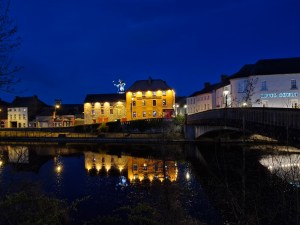
We return to our charming guesthouse walking along the beautifully lit River Nore, all the pubs are full, the statue of the kilkenny cats standing proudly in the moonlight. The next morning, after an excellent breakfast at La Coco, which is always full – the ‘cats’ seem to have got the word out to come and have a coffee or a muffin to take away – we explore the merchant side of the town. Kilkenny once made its fortune from trade, wool and black marble. In fact, Kilkenny is sometimes nicknamed ‘the marble city’. The town built a castle and ramparts in the 12th century and from that time onwards became a prosperous trading town under Anglo-Norman control. The former home of the Rothe family – which can be visited – is a unique example in Ireland of a 16th-century merchant house.
Kilkenny’s power peaked in the seventeenth century, when, following the rebellion of 1641, the town even served for a decade as the capital of an alternative government of Ireland, the Irish Confederation, which was subsequently overthrown by the arrival of Cromwell’s troops. As you can see, Kilkenny has been discreetly at the heart of Irish history for a very long time.
We also take advantage of our visit to visit Smithwicks, an Irish beer almost as famous as Guinness, and then Kilkenny Design, the twin store of the one on Nassau Street in Dublin. This shop is in fact the outcome of the Kilkenny Design Workshop, which was founded in the sixties by a government initiative to promote design for industry and craft. It was worldwide a unique institution at that time, in fact a pioneering vision of modern start-up incubators. This led to the creation of the Kilkenny Design Centre, which is dedicated to selling made-in-Ireland products. This desire to sell local crafts can be seen throughout the city centre, with many small shops, few chains and few closures. This is very rare in Ireland, according to my Irish friend.
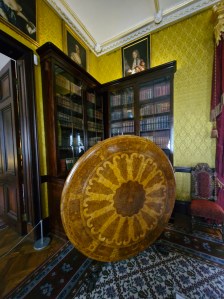
All of this is dominated by the enormous castle, which sits peacefully above the small town and bears witness to its past, having been the stronghold of the Butler dynasty for over 500 years. The famous Butler family arrived in Ireland with the Anglo-Norman invasions (one of the variants is the French name le Bouteiller, as originally a “butler” was in charge of the king’s cups). They later acquired their letters of nobility, even becoming Earls of Ormond. The Butlers had strong links with the English crown and, fun fact, Ann Boleyn was a Butler. At some point, short of money, the Butler family finally left the castle in the 1930s and it was sold to the state for the symbolic sum of £50. A visit to the castle nonetheless reveals its former splendour and reflects nineteenth-century bourgeois life – in fact, it’s a sort of more urban Kylemore.
First a bastion of religious and then political resistance, Kilkenny has been avant-garde in many ways. But that doesn’t mean it has become a museum town. And it we return to Dublin both admirative and flabbergasted by Alice Kyteler’s cheeky feminism.
Catly yours
Pauline Chatelain
 Cahiers d'Irlande